
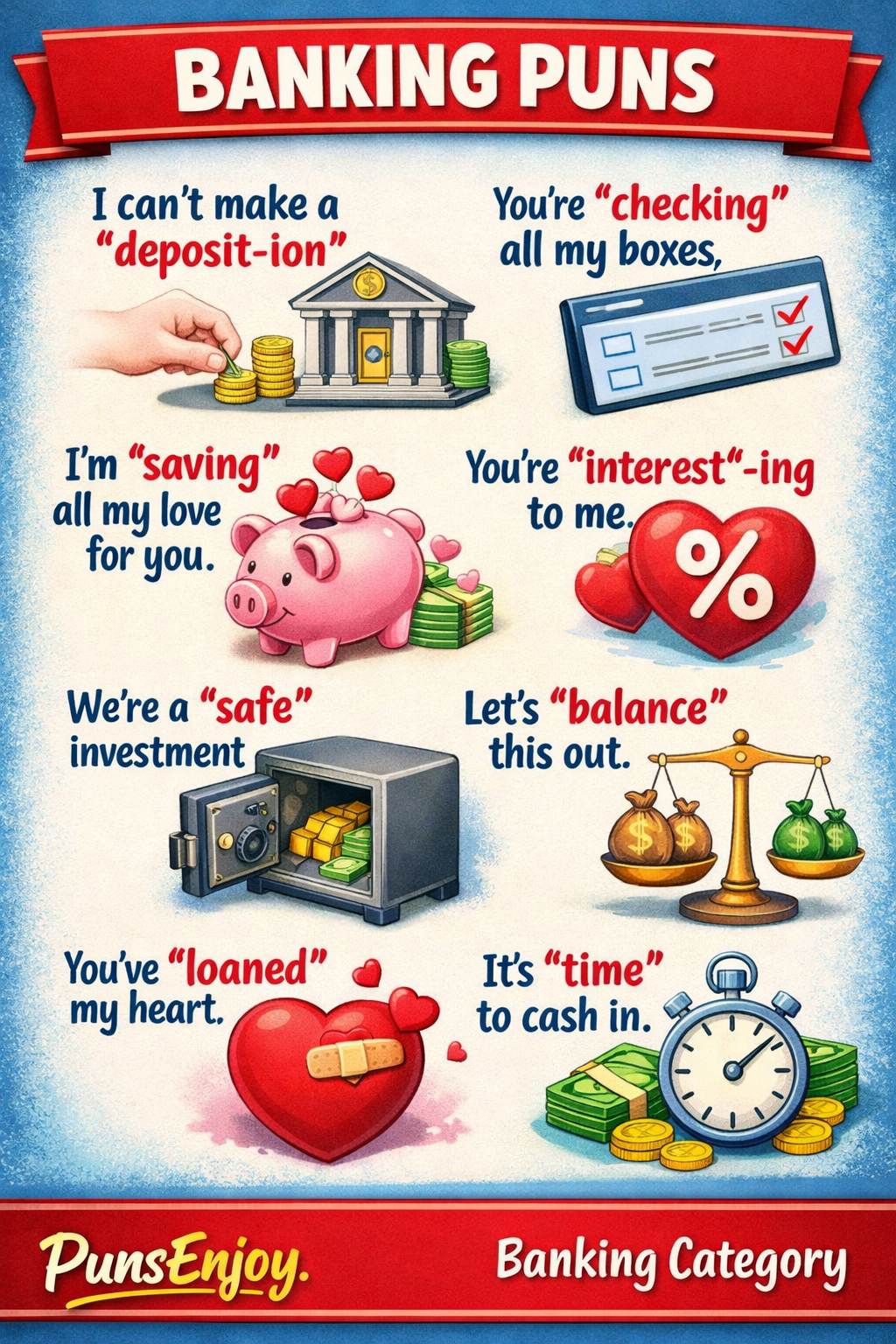
Introduction
Money makes the world go round, but let’s be honest—talking about finances can sometimes be incredibly dry. Whether you are sitting through a dense quarterly earnings meeting, trying to explain the basics of a savings account to a teenager, or simply looking for a way to break the ice at a corporate networking event, the tension surrounding monetary discussions is palpable. That is exactly where banking puns come in to save the day.
There is an undeniable magic to taking a subject that is traditionally viewed as rigid, serious, and stress-inducing and flipping it on its head using clever wordplay. Banking puns allow us to laugh at the very thing that causes us the most anxiety: our wallets. From witty teller banter to clever social media captions about compound interest, financial wordplay is a niche but highly effective form of comedy.
In this comprehensive, SEO-optimized guide, we are going to withdraw a massive amount of humor from the joke bank. Whether you are a financial advisor looking to charm a client, a social media manager hunting for the perfect caption, or just someone who appreciates a ridiculously good dad joke, this article has you covered. We will explore the psychology behind financial humor, dive into over a hundred meticulously categorized banking puns, look at how modern finance has shaped new jokes, and even provide a masterclass on how to use these puns in your marketing strategy. So, buckle up, keep your hands inside the vehicle, and let’s make some cents.
Table of Contents
- The Wealth of Humor: Why Banking Puns Make Cents
- A Penny for Your Thoughts: The Best One-Liner Banking Puns
- Making a Withdrawal from the Pun Bank: Classic Deposit and Withdrawal Jokes
- Interest-ing Wordplay: Puns About Loans and Interest Rates
- Checking In: Hilarious Checking Account Puns
- Saving the Day: The Best Savings Account Puns
- Cash Me Outside: Physical Currency and Cash Puns
- Investing in Laughs: Stock Market and Investment Puns
- Credit Where Credit is Due: Credit Card and Credit Score Puns
- Wealth Management and Financial Advisor Puns for High Rollers
- Cryptocurrency and Modern Banking Puns: The Future of Finance Humor
- Teller Jokes: Funny Interactions with Bank Employees
- How to Use Banking Puns in Marketing and Social Media
- The History of Financial Wordplay: How Banking Puns Evolved
- Avoiding Bad Checks: When Banking Puns Go Wrong
Frequently Asked Questions (FAQs)
- Why are banking puns so popular in professional settings?
- Can using banking puns on social media actually improve engagement for financial institutions?
- Are there any banking puns that are safe for children to understand?
- How do I come up with my own original banking puns?
- What is the best banking pun for a retirement card?
Conclusion
The Wealth of Humor: Why Banking Puns Make Cents
To understand why banking puns are so effective, we have to look at the psychological concept of incongruity theory. This theory suggests that humor arises when there is a mismatch between what we expect to happen and what actually happens. The world of banking is built on strict rules, absolute precision, legal jargon, and serious consequences. When you introduce a silly pun into that environment, the brain experiences a delightful whiplash. The sheer contrast between a sterile bank vault and a groan-inducing dad joke is what makes financial wordplay so brilliantly funny.
Furthermore, money is a universally understood concept. You don’t need a PhD in economics to understand a joke about being “broke” or “making a deposit.” Because the vocabulary of finance—words like interest, balance, change, check, and draft—bleeds so heavily into our everyday language, the opportunities for double entendres are practically limitless. When a comedian or a marketer uses a banking term in a non-banking context, they are relying on the audience’s shared linguistic database to bridge the gap between the two meanings.
Laughing at money also serves as a coping mechanism. Financial literacy is a stressful subject for many people. Inflation, debt, taxes, and the cost of living are heavy burdens. Banking puns act as a pressure release valve. By reducing a massive, intimidating concept like a mortgage rate down to a silly punchline, we strip the fear away. Humor gives us a fleeting sense of control over our finances, even if it’s just for the duration of a chuckle. In short, banking puns don’t just make us laugh; they make the intimidating world of finance feel distinctly more human.
A Penny for Your Thoughts: The Best One-Liner Banking Puns
One-liners are the bread and butter of the pun world. They are quick, punchy, and usually elicit an immediate groan from the audience. The best banking one-liners rely on words that have dual meanings in both everyday conversation and financial sectors. Here is a deep dive into some of the absolute best one-liner banking puns, along with a brief look at why the linguistics work so well.
- “I’m reading a book about anti-gravity. I can’t put it down, but I really hope it doesn’t affect my bank balance.” This plays on the concept of “balance” as both a physical state and a monetary state.
- “Why did the banker break up with his girlfriend? Because there was no interest.” The word “interest” perfectly bridges the gap between romantic attraction and the financial fee charged for borrowing money.
- “I used to be a banker, but I lost interest.” A classic, succinct pun that works entirely because the phrase “losing interest” is a common idiom for boredom.
- “How do bankers stay cool in the summer? They stand near the fans of their capital.” This relies on the double meaning of “capital” (wealth) and the physical concept of moving air (fans).
- “I asked the bank for a loan, and they asked for my balance. I told them I do yoga.” Here, “balance” switches from an accounting term to a physical posture, creating a sudden, humorous pivot.
- “Why don’t banks ever get lost? Because they always have good cents!” A phonetic pun playing on “sense” (direction/logic) and “cents” (currency).
- “What do you call a banker with a fear of the ocean? A loan shark who refuses to float.” This combines financial slang (“loan shark”) with a literal, irrational fear of water.
- “I tried to explain to my banker that I have a cash flow problem. He suggested I buy a better faucet.” Taking the metaphorical term “cash flow” far too literally is a cornerstone of pun-based comedy.
- “Why did the cookie go to the bank? Because it wanted to get its dough checked.” A beautifully simple integration of baking terminology (“dough”) and banking terminology (“checking”).
- “My bank is the most optimistic place on earth. They’re always giving me checks.” “Checks” serves as both a financial instrument and a mark of approval or validation.
Making a Withdrawal from the Pun Bank: Classic Deposit and Withdrawal Jokes
The fundamental actions of banking—putting money in and taking money out—provide a fertile ground for comedic exploration. Deposit and withdrawal jokes often play on the physicality of these actions, treating money as if it were a physical substance or an emotional state of being.
Consider the classic riddle: “Where do fish keep their money? In a river bank!” This joke works because it subverts our expectation. When we hear “bank” in a financial context, we picture a brick-and-mortar building with tellers and vaults. By pivoting to the geographical definition of a riverbank, the joke creates a whimsical image of fish swimming up to a mossy ledge to deposit their coins.
Another favorite is, “Why did the man put his money in the freezer? He wanted cold hard cash.” This pun relies on the common colloquialism “cold hard cash,” which implies tangible, spendable money rather than digital numbers on a screen. By taking the adjective “cold” literally, the joke creates a highly visual, slightly absurd scenario.
Then we have the emotional deposits: “I made a deposit into the Bank of Friendship today.” This metaphorical use of banking terms is ubiquitous in self-help and corporate team-building literature. It frames emotional labor and kindness as a financial transaction, making it ripe for parody. You can easily twist this into a pun by saying, “I tried to make an emotional deposit, but my friend said my vibes bounced.”
Withdrawals, on the other hand, often focus on the pain of losing money. “I’m experiencing severe withdrawal symptoms,” is a phrase usually reserved for addiction, but when a stand-up comedian says it while holding an empty wallet, the double meaning instantly clicks with the audience. The beauty of deposit and withdrawal puns is their absolute relatability; everyone knows the feeling of a heavy deposit and the sorrow of a swift withdrawal.
Interest-ing Wordplay: Puns About Loans and Interest Rates
If there is one area of banking that causes the most confusion—and therefore the most comedic opportunity—it is the concept of interest. Interest is fundamentally an abstract concept: the cost of borrowing money or the reward for lending it. Because it is an invisible number that grows over time, it perfectly mimics human concepts like fascination, attraction, and attention.
The pickup line is the most common vehicle for interest puns. “Are you a high-yield savings account? Because I’m really interested in seeing you grow.” Or, the slightly more desperate: “If you were a loan, you’d have a 0% APR, because you cost me nothing but give me everything.” These jokes work by masking a sincere compliment inside the dry, often frustrating jargon of lending.
Interest puns also excel at pointing out the absurdity of modern economics. “My bank told me I could earn 0.01% interest on my savings. I told them I was more interested in keeping my sanity.” Here, the pun highlights the notoriously low return on traditional savings accounts, using humor as a form of financial critique.
Let’s not forget about compound interest, which Albert Einstein allegedly called the eighth wonder of the world. “I asked my banker if my interest would compound. He said, ‘Only if you commit a financial crime.'” This plays on the secondary definition of “compound”—to make something worse by adding to it—flipping a positive financial concept into a joke about prison. By heavily leaning on the double meanings of “interest” and “compounding,” these puns manage to make the most tedious aspect of finance genuinely entertaining.
Checking In: Hilarious Checking Account Puns
Checking accounts are the workhorses of the personal finance world. They are active, fluid, and constantly moving, which makes them an excellent subject for wordplay. The word “check” itself is a linguistic goldmine, serving as a noun (a piece of paper, a pattern), a verb (to inspect, to stop), and an adjective (a checkered flag).
“I tried to write a check for my laziness, but it bounced.” This joke is a masterclass in double entendres. A bounced check is a financial penalty, but in this context, the laziness itself is what “bounced,” implying the writer couldn’t be bothered to finish the thought.
Another strong contender: “I wanted to see how my finances were doing, so I gave them a reality check.” This seamlessly blends the banking instrument (a check) with the idiom of facing harsh truths.
“Are you a checking account? Because I want to check you out.” While this leans heavily into cheesy pickup line territory, it perfectly captures the essence of a checking pun. The fluidity of a checking account also lends itself to jokes about speed and movement. “My checking account is like a fast-food drive-thru: money goes in, and five minutes later, it’s gone.” While not a pure pun, it relies on the linguistic association we have with the speed of “checking” out.
We can also look at the structural elements of the account. “Why did the checking account go to therapy? Because it had too many outstanding issues.” An “outstanding check” is a real banking term for a check that has been written but not yet cleared. By twisting “outstanding” to mean “unresolved problems,” the pun achieves a brilliant layering of meaning that appeals to both accountants and comedians alike.
Saving the Day: The Best Savings Account Puns
If checking accounts are the chaotic, spending side of finance, savings accounts represent discipline, patience, and security. Therefore, savings puns often play on concepts of rescue, safety, and hoarding. The word “save” is deeply ingrained in our hero mythology—saving the day, saving a life—which makes applying it to money inherently funny.
“Where does Batman keep his money? In a savings account, because he’s always saving the day.” This joke works entirely on the pivot of the word “save.” The audience expects a joke about the Batmobile or a utility belt, but the mundane reality of a high-yield savings account subverts that expectation perfectly.
Piggy banks are the universal symbol of savings, making them a staple in this category. “I told my piggy bank a joke, but it just cracked up.” This is a simple, visual pun that works well for younger audiences. For a more adult twist: “My piggy bank is on a strict diet. No more junk bonds.” This merges the idea of a diet (saving/regulating intake) with an investment term (junk bonds), creating a sophisticated financial pun.
Savings puns also frequently touch on the difficulty of actually saving money. “I have a savings account for emergencies. It’s called my checking account.” This darkly comedic observation uses the technical definition of savings against the harsh reality of living paycheck to paycheck. “I tried to save money, but it just evaporated. I guess my savings account has low self-esteem.” By personifying the bank account, the pun turns a frustrating financial reality into an absurdist joke.
Cash Me Outside: Physical Currency and Cash Puns
Even in an increasingly digital world, physical cash remains a primary focus of financial humor. The word “cash” has evolved in modern slang to mean “success” or “to obtain” (e.g., “cash me outside,” “cash in”), giving it a versatile edge for pun creation. Furthermore, cash is associated with specific physical traits—it’s green, it’s paper, it has faces on it, it folds, and it jingles.
“Cash me outside, how ‘bout dat?” became a viral internet meme, but the banking community quickly hijacked it: “Cash me outside, how ‘bout dat? Said the ATM to the debit card.” This places the slang phrase into a literal banking context, making it uniquely funny to anyone who has ever stood in the cold waiting for a cash machine.
Let’s look at the physical properties. “Why is money green? Because it’s constantly being laundered.” Money laundering is a serious federal crime, but framing it as a laundry joke (washing clothes, turning things green from bleach) softens the edge and creates a highly effective pun.
“I’m feeling flush today.” This is a classic idiom that means having a lot of money, but it originates from the plumbing term for a toilet, creating a subtly gross but hilarious double meaning. “I don’t always carry cash, but when I do, it’s because my card declined.” Again, this bends the expectation of a boast into a self-deprecating financial reality.
Paper money also gives us the opportunity to play with historical figures. “Why didn’t George Washington ever get lost? Because he was always on the one.” A simple, clean pun that works across all age demographics, proving that cash puns don’t always need to be complex to be effective.
Investing in Laughs: Stock Market and Investment Puns
The stock market is inherently volatile, unpredictable, and driven by emotion—making it the perfect punching bag for comedians. Investment puns rely heavily on the specific, bizarre jargon of Wall Street: bulls, bears, dividends, margins, and portfolios. To the average person, these terms sound like absolute gibberish, which makes twisting their meanings incredibly satisfying.
“I told my wife I wanted to invest in a bull market. She asked if I was planning to start a rodeo.” This pun preys on the ignorance of financial jargon. A “bull market” means prices are rising, but taking it literally as an actual angry bull creates a fantastic visual disconnect.
“Why did the stock market go to the doctor? It had a bad case of the bears.” Playing on the term “bear market” (when stock prices are falling), this joke anthropomorphizes the economy, turning a financial downturn into a literal illness.
Dividends are another rich source of wordplay. “I’m dividing my attention, but hopefully, it pays dividends.” This takes the financial concept of a dividend (a sum of money paid regularly by a company to its shareholders) and applies it to human focus and productivity. It suggests that the effort put into a task will yield a proportional reward, blending financial logic with everyday motivation.
“I’m on the margin of success, but my broker says I need to put up more collateral.” This is a slightly more intellectual pun that requires a basic understanding of margin trading (borrowing money to invest). By applying “margin” to personal success, it paints a picture of someone living dangerously close to the edge, both financially and existentially. Investment puns work best when they highlight the sheer absurdity of gambling one’s life savings on the whims of the New York Stock Exchange.
Credit Where Credit is Due: Credit Card and Credit Score Puns
Credit is arguably the most stressful aspect of modern personal finance. The invisible, three-digit credit score dictates whether you can buy a house, a car, or even get a job. Because the stakes are so high, credit puns often carry a hint of dark, cynical humor. They allow us to laugh at the traps of consumer debt and the relentless pressure to keep our scores high.
“I would tell you a joke about my credit score, but it’s too low to get a laugh.” This self-deprecating pun equates the mechanics of credit approval with social approval. Just as a low credit score gets your card declined at a store, a “low” joke gets declined by the audience.
“Are you a credit card? Because you’re constantly on my mind, and you’re ruining my life.” This is a brilliant subversion of the traditional pickup line. It starts romantic but pivots aggressively into the harsh reality of mounting credit card debt and the anxiety of monthly payments.
“Let’s give credit where credit is due.” This is an everyday idiom, but when used by a financial advisor, it becomes an unintentional pun. To push it further: “I tried to give credit where credit was due, but my utilization ratio was too high, so the bank said no.” This weaves a common phrase directly into the technical jargon of credit scoring, resulting in a dense, highly rewarding pun for financial nerds.
“I have a love-hate relationship with my credit limit. I love to reach it, and I hate that I reached it.” This isn’t a traditional wordplay pun, but rather a structural pun based on the contradictory nature of consumerism. It highlights the bizarre psychological loop of wanting to buy things, being allowed to buy things via credit, and then suffering the consequences of buying those things.
Wealth Management and Financial Advisor Puns for High Rollers
Wealth management is a sector of banking draped in luxury, bespoke suits, golf courses, and extreme discretion. The humor in this category relies heavily on contrasting the hyper-elite world of the one percent with the mundane realities of everyday life, or by poking fun at the overly complex language used by financial advisors.
“Why do financial advisors make terrible comedians? Because their timing is always tied to the market, and their delivery has too many hidden fees.” This joke is a critique of the wealth management industry disguised as a pun. It plays on the word “delivery” (delivering a joke vs. delivering a financial product) to take a jab at the lack of transparency in advisory fees.
“I asked my wealth manager how to become a millionaire. He said, ‘Start with two million and invest with me.'” This is an old Wall Street adage, but it functions perfectly as an anti-pun. The expectation of a clever financial trick is subverted by the blunt admission of industry failure.
“I’ve got a diverse portfolio: 10% in stocks, 20% in bonds, and 70% in regret.” This is highly relatable financial humor that uses the structural format of an asset allocation statement to deliver an emotional punchline. The word “portfolio” usually implies careful curation, making the inclusion of “regret” a hilarious contrast.
“Why did the wealthy banker sleep so well? Because his money was working the night shift.” This personifies capital, treating money as employees who toil away while the wealthy elite rest. It’s a lighthearted poke at passive income and the concept of making money while you sleep, which is the holy grail of wealth management.
Cryptocurrency and Modern Banking Puns: The Future of Finance Humor
The advent of cryptocurrency, blockchain technology, and decentralized finance (DeFi) has injected a massive amount of new vocabulary into the financial lexicon. Words like “Bitcoin,” “Ethereum,” “mining,” “hash,” “block,” and “crypto” are inherently weird sounding, making them absolute goldmines for modern puns. Crypto puns often bridge the gap between traditional banking and cutting-edge tech humor.
“I tried to explain cryptocurrency to my grandmother. Now I have to mine her some digital coal.” This joke takes the crypto term “mining” (the process of validating transactions and creating new coins using computer power) and regresses it back to the industrial revolution concept of literal coal mining. It highlights the generational gap in understanding new finance.
“Why did the crypto investor go to the doctor? He had a bad case of FOMO (Fear Of Missing Out) and his blockchain was congested.” “Blockchain congestion” is a real technical issue where network traffic slows down transactions. By treating it like a medical sinus infection, the pun becomes highly visual and absurd.
“Are you a Bitcoin? Because you’re highly volatile, but I’m still obsessed with you.” This mirrors the credit card pickup line but updates it for the modern era. Volatility is the defining characteristic of crypto, and framing it as an attractive personality trait is a great ironic twist.
“I’m not saying I’m addicted to crypto, but if my hard drive crashes, I’m literally broke.” This plays on the distinction between physical fiat currency and digital assets. If a traditional bank burns down, your money is still insured by the government. If your crypto wallet crashes, your money is gone, a reality that makes for excellent, albeit slightly painful, punning.
Teller Jokes: Funny Interactions with Bank Employees
Bank tellers are the face of the financial industry. They deal with hundreds of people a day, ranging from wealthy business owners to confused elderly citizens and frustrated customers trying to cash out-of-state checks. Tellers have a unique, deadpan perspective on humanity, making teller jokes a beloved subgenre of banking humor. These puns often rely on dialogue and situational irony.
Customer: “I’d like to make a deposit.”
Teller: “Great, are you depositing cash or a check?”
Customer: “Neither, I’m depositing my faith in the banking system.”
Teller: “I’m sorry, our faith reserves are currently at zero.”
This dialogue-format joke works because the customer is being overly philosophical in a highly transactional environment, and the teller responds with the cold, mechanical logic of a bank employee.
“Why do bank tellers make the best detectives? Because they always know how to follow the paper trail.” A fairly straightforward pun, but it highlights the meticulous, record-keeping nature of the job.
“I went to the bank and asked the teller to check my balance. She pushed me.” A timeless, physical comedy pun. “Checking your balance” is an abstract request to view an account total, but the teller interprets it as a literal test of the customer’s physical center of gravity.
“My bank teller is so optimistic. Every time I come in with a negative balance, she says, ‘Well, at least you’re making a positive impact!'” This joke plays on the mathematical terms “negative” and “positive,” flipping a terrible financial situation into a pseudo-motivational speech. It perfectly captures the forced cheerfulness often required in customer service roles.
How to Use Banking Puns in Marketing and Social Media
Knowing a good pun is one thing; leveraging it for engagement is another. In the modern digital landscape, financial institutions—from massive corporate banks to localized credit unions—are realizing that traditional, stuffy marketing no longer resonates with younger demographics like Millennials and Gen Z. These groups value authenticity, humor, and brands that don’t take themselves too seriously.
Using banking puns in social media marketing is a highly effective, low-cost strategy to humanize your brand. Imagine a credit union posting on Instagram: “Ready for the weekend? We’re feeling pretty check-y.” It’s groan-worthy, but it works. It stops the user from mindlessly scrolling, prompts a smirk, and increases the dwell time on the post, which signals the algorithm to boost its visibility.
Banking puns are incredibly versatile for different holidays and seasons. For Tax Day: “We know taxes can be taxing, but don’t let them drain your cents.” For Halloween: “Have a frightfully good weekend, and don’t let your spending haunt you!” For Valentine’s Day: “We loan you our heart.” By mapping puns to the cultural calendar, social media managers can maintain a consistent, engaging voice all year round.
However, context is everything. If your bank is posting about a serious economic downturn, a severe market crash, or changes to overdraft fees, slapping a pun on it will come across as tone-deaf and insensitive. Puns should be reserved for lighthearted topics: saving tips, celebrating financial literacy month, or highlighting community events. When used correctly, a well-timed banking pun can transform a boring financial institution from a faceless corporation into a witty, relatable companion on a customer’s financial journey.
The History of Financial Wordplay: How Banking Puns Evolved
To truly appreciate banking puns, we have to look at their historical evolution. The intersection of money and language is as old as currency itself. In ancient Rome, the word for money (pecunia) was derived from the word for cattle (pecus). This etymological overlap was essentially the Roman version of a pun—equating livestock with wealth in everyday speech.
As banking evolved through the Middle Ages with the rise of the goldsmiths (who acted as early bankers by holding gold in secure vaults and issuing paper receipts), the language of finance became more complex. The word “bank” itself comes from the Italian word banca, meaning the bench or table at which moneylenders sat in market squares. If a moneylender ran out of money or acted fraudulently, angry customers would literally break his bench, giving us the word “bankrupt” (from banca rotta, or broken bench). While not a joke, this violent historical reality birthed financial vocabulary that is still used in puns today.
The modern banking pun as we know it truly exploded in the late 19th and early 20th centuries. This was the era of vaudeville, the golden age of newspapers, and the rise of the “dad joke.” As financial literacy spread to the middle class, terms like “checking account,” “mortgage,” and “interest” entered common parlance. Vaudeville comedians quickly realized that the dry, serious language of the local bank teller was the perfect fodder for subversion.
With the invention of the internet and social media, the banking pun has experienced a renaissance. Memes, Twitter (X) threads, and Reddit communities (like r/Accounting or r/Personalfinance) have democratized financial humor. Today, banking puns are a shared cultural language used not just by comedians, but by everyday people to navigate the incredibly complex, often frustrating modern financial system.
Avoiding Bad Checks: When Banking Puns Go Wrong
While banking puns are a fantastic tool, they are not without risk. The line between a charmingly cheesy joke and a cringe-inducing disaster is razor-thin. Understanding when banking puns fail is just as important as knowing how to execute them.
The most common failure occurs when a pun is forced into a situation that demands absolute clarity and professionalism. Imagine a loan officer sitting across from a grieving widow who is trying to sort out her late husband’s mortgage. If the officer says, “Well, let’s make sure we don’t overdraft our emotional banks!” they will likely lose their job. Empathy must always supersede humor. If there is any emotional weight or high-stress involved, the puns must be immediately shelved.
Another pitfall is the “Inside Baseball” problem. If a bank’s marketing team creates a pun that requires a master’s degree in quantitative finance to understand, it will alienate 99% of the audience. A joke like, “Are you a convexity mismatch? Because my yield curve is bending for you” is far too niche. Good puns are accessible. They use words that everyone knows, but twist them in unexpected ways.
Finally, there is the risk of repetition. Because banking vocabulary is relatively limited compared to the entirety of the English language, the same puns get recycled endlessly. If a brand relies solely on “making cents” and “checking in,” the audience will eventually experience pun fatigue, leading to eye-rolls rather than engagement. The key to avoiding bad checks is moderation, context awareness, and a willingness to step away from the obvious wordplay to find something genuinely clever.
Frequently Asked Questions (FAQs)
Why are banking puns so popular in professional settings?
Banking puns are popular in professional settings because they serve as excellent icebreakers. Finance is inherently stressful, strict, and numbers-driven. Dropping a well-timed pun during a dry meeting or a networking event introduces a moment of levity that humanizes the speaker. It shows that the professional is knowledgeable enough about the industry to play with its terminology, making them appear confident and approachable rather than rigid.
Can using banking puns on social media actually improve engagement for financial institutions?
Absolutely. Social media algorithms favor content that generates interaction, and humor is one of the most reliable ways to get people to comment, like, or share. Younger demographics, in particular, actively reject corporate stiffness. When a bank or financial advisor posts a clever pun, it differentiates their brand from competitors who only post dry interest rate updates. A groan-worthy comment from a user saying, “That was terrible,” still counts as positive engagement in the eyes of the algorithm.
Are there any banking puns that are safe for children to understand?
Yes, there are hundreds. The best ones rely on physical concepts rather than abstract economic theories. For example: “Where do polar bears keep their money? In a snowbank!” or “Why did the penny go to school? To get more cents!” These jokes are perfectly tailored for children because they merge basic financial concepts (banks, pennies) with familiar childhood imagery (snow, school), making them highly educational as well as funny.
How do I come up with my own original banking puns?
The trick to creating original puns is to make a massive list of financial terms (mortgage, equity, lien, amortization, dividend, vault) and write down every non-financial definition or synonym for those words. Then, try to force them into common idioms or sentence structures. For example, “lien” sounds exactly like “lean.” You can then build a joke: “Why did the skinny banker get a promotion? Because he was always on a lien.” Consistency and word association are the keys to inventing your own.
What is the best banking pun for a retirement card?
Retirement is a delicate milestone that mixes celebration with the reality of aging and fixed incomes. A perfectly balanced pun for a retirement card would be: “Congratulations on your retirement! May your days be full of interest, your stress be compounded, and your happiness yield high returns.” It uses standard banking terminology in a purely positive, metaphorical way, which respects the seriousness of retiring while still delivering a clever, themed punchline.
Conclusion
Navigating the world of personal finance doesn’t have to feel like a trip to the dentist. While money management requires discipline, focus, and a solid understanding of economic principles, it also leaves plenty of room for laughter. From the simplest “cents” joke to a complex critique of cryptocurrency volatility, banking puns prove that finance and fun are not mutually exclusive.
We have explored how these jokes act as psychological pressure valves, how they bridge the gap between complex Wall Street jargon and Main Street reality, and how they have evolved from ancient Roman wordplay to modern social media marketing strategies. Whether you are a financial professional looking to charm a client, a social media manager trying to boost engagement, or just someone who appreciates the sheer, groan-inducing beauty of a well-crafted dad joke, the world of financial wordplay is rich with rewards.
So, the next time you find yourself staring at a depressing bank balance or scratching your head over a confusing mortgage document, remember to take a breath. After all, if you can’t find the humor in your finances, you might just end up broke—both in the wallet and in spirit. Keep making cents, check your funny bone, and never lose interest in a good laugh.